
Lauderdale County Court Records After Arrest
A jail arrest creates a custody record first. The Lauderdale County Detention Facility records the booking, arresting agency, booking number, booking date, listed charge text, bond, and mugshot when the person appears on the public roster. The court record is a different record. It begins when the charge moves into a court channel, either through an early complaint, prosecutor action, grand jury indictment, or other filing that opens or updates the case.
Felony criminal cases are handled by the 10th Judicial District Circuit Court, which covers Lauderdale, Clarke, Kemper, and Wayne counties. The county court-system page states that Circuit Court handles felony criminal cases and unlimited civil matters. For custody and booking detail, use Lauderdale County jail inmate records. For booking photos, use the Lauderdale County jail mugshots page. Court records after a jail arrest should be checked through the clerk and court channels once case information is available.
Find Court Records After a Lauderdale Arrest
The main local court contact is the Lauderdale County Circuit Clerk. The clerk page lists Circuit Clerk Renee Covert and the office at 2600 Courthouse Blvd, Meridian, MS 39301, with phone 601-482-9731 and email circuitclerk@lauderdalecounty.org. The MEC Lauderdale County court information page also lists the Circuit Court location and contact data. Full public electronic access depends on Mississippi Electronic Courts and the records available for that case type.
- Start with the jail roster to capture the exact name spelling, booking number, arresting agency, booking date, and listed charges.
- Call the jail at 601-482-9801 if the bond amount, current charge list, or case number must be current.
- Check the relevant court channel. Felony matters normally route to Circuit Court after prosecutor filing or grand jury action.
- Use the clerk or MEC court information page when a case number or defendant name is available.
- For tickets and lower-level matters, check Justice Court or Municipal Court based on the charge and arresting agency.
The sheriff FAQ says tickets are paid at Lauderdale County Justice Court on the first floor of the courthouse, and gives 601-482-9879 for that office. A Municipal Court matter may be tied to the City of Meridian or another municipality rather than the Circuit Court. If the public court portal does not show a case yet, the filing may not be docketed, or the matter may be in a different court.
The MEC screenshot below shows the official court information route for Lauderdale County Circuit Court. The source is the MEC court information page, which is a court-contact and access starting point rather than the jail roster.
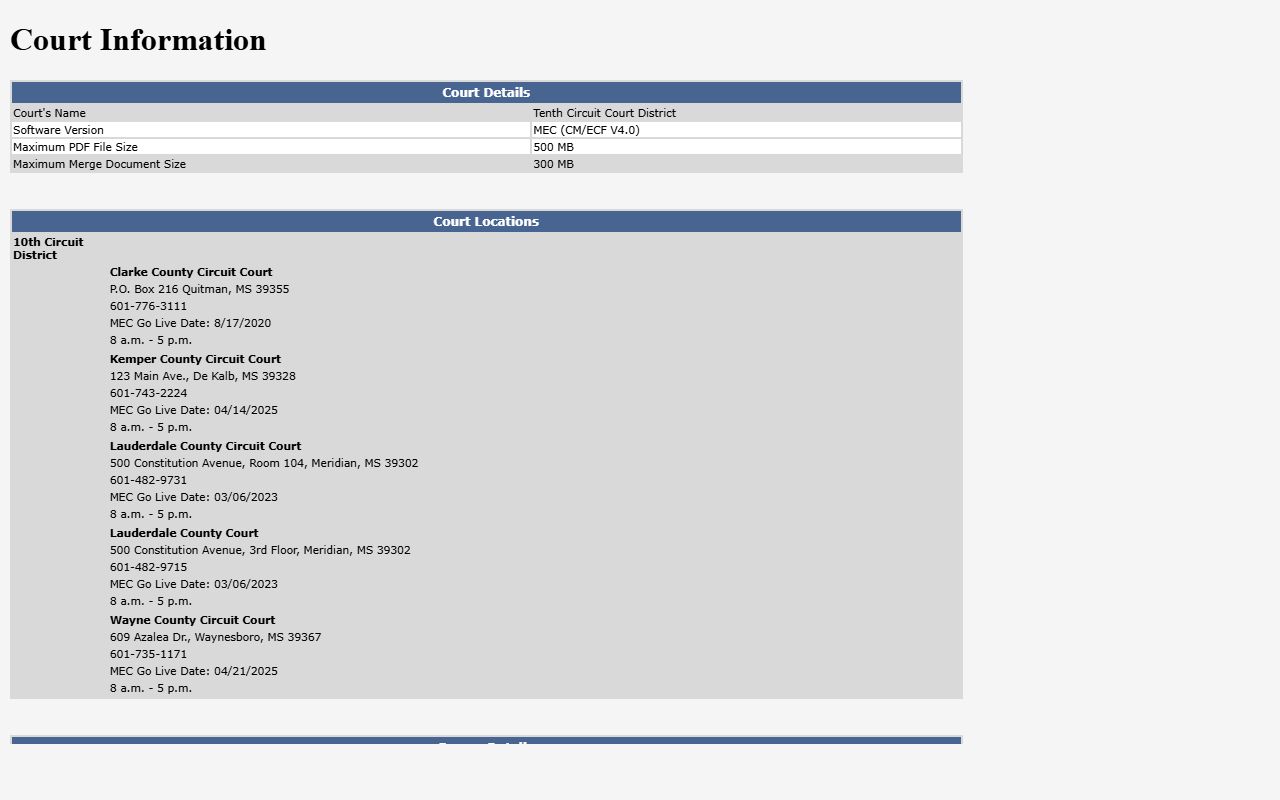
The court page helps confirm where to ask for filed charges after an arrest, while the jail roster remains the source for current detention status.
Charges Filed After an Arrest
Booking charges are often the first public charge text a family member sees, but they may not be the final prosecutor-filed charges. A complaint can start a lower-level case or early criminal process. An information is a prosecutor-filed charging document used in some procedures. An indictment is the grand jury charging instrument for felony prosecution. District Attorney Kassie Coleman serves Mississippi's 10th Circuit Court District, including Lauderdale County, and the district attorney decides how felony charges are pursued in Circuit Court.
| Document | Who Uses It | What It Means After Arrest |
|---|---|---|
| Complaint | Officer, complainant, or prosecutor depending on court process | An early charging paper that can begin a criminal case or support an arrest warrant. |
| Information | Prosecutor | A prosecutor-filed charge used in some criminal procedures instead of a grand jury indictment. |
| Indictment | Grand jury | A formal felony charge that moves the case into Circuit Court prosecution. |
Lauderdale County Charge Status
Court records after a jail arrest can change several times. A listed jail charge may be amended, reduced, dismissed, carried to a grand jury, or replaced by different prosecutor language. The roster profile itself warns that charges and bail amounts may change after court appearances and may not be current. That warning is the reason bond companies and people posting bail are told to contact detention staff for the correct bail amount, charges, and case numbers.
| Status | Meaning in a Court Record |
|---|---|
| Pending | The charge remains open and the case has not reached a final outcome. |
| Amended | The prosecutor or court has changed the charge language, level, or count. |
| Reduced | The charge has moved to a lesser offense or lower level. |
| Dismissed | The charge was ended by court order or prosecutor action. |
| Nolle prosequi | The prosecutor declined to continue that charge. |
| Convicted | The case ended in a guilty plea, verdict, or qualifying adjudication. |
Bond Changes After Court Arrest Records
Bond information on the public roster is helpful but not final. The sheriff FAQ says bond information is available by calling 601-482-9801. A judge may change bond after a first appearance or later hearing. A person can also remain in custody even after a county bond appears available if another agency has a hold, detainer, probation or parole violation, federal hold, or ICE detainer.
Common Mississippi bond terms include cash bond, surety bond through a licensed bail agent, property bond where the court allows it, recognizance or personal bond, and no-bond hold. A PR bond means release on a promise to appear rather than secured money. A detainer or hold is another agency's request that can block release.
| Bond Type | How It Works |
|---|---|
| Cash bond | Cash is posted for release while the case is pending. |
| Surety bond | A licensed bail agent posts bond under court rules. |
| Personal recognizance | The court allows release based on a promise to return. |
| No-bond hold | The person is not eligible for release on that matter at that time. |
Fees and payment methods for bail were not located on an official Lauderdale County page. Do not infer online bond payment availability from the roster alone.
Warrants Before a Lauderdale Arrest
No separate searchable Lauderdale County active-warrant database was located in the sheriff website research. The sheriff FAQ says that when someone presses charges and a judge grants a warrant, the office verifies the warrant is on file and attempts to locate and arrest the person. If the complainant has additional information or changes, the FAQ points to 601-482-9804.
The same FAQ says warrant information is not available by phone for someone asking whether they personally have a warrant. It advises approaching a law enforcement officer and asking. After an arrest on a warrant, the booking may appear on the county roster if the person is housed at the Lauderdale County Detention Facility. Court records can then show failure-to-appear, contempt, bench warrant, probation violation, or other warrant-related language.
Charges vs Convictions
Being arrested and charged is not the same as being convicted. A charge is an accusation or filed count. A conviction requires a guilty plea, verdict, or other qualifying court outcome. This distinction matters in Lauderdale County court records after an arrest because the public jail roster can show charge text before the case reaches a final result.
| Charge | Conviction | |
|---|---|---|
| Stage | Accusation, complaint, information, or indictment | Final court outcome after plea, verdict, or adjudication |
| Proof | Lower threshold at arrest or filing stage | Requires the criminal case to resolve against the defendant |
| Can change | Yes, charges can be amended, reduced, or dismissed | Yes, but changes usually require later court action |
Sealed and Expunged Arrest Records
Mississippi expunction law can allow eligible arrests, charges, or convictions to be expunged in certain circumstances, including dismissed, dropped, no-disposition, acquittal, and some conviction scenarios. The controlling court process matters. The research did not find a county web policy promising automatic mugshot or roster removal after dismissal or expunction.
| Sealed | Expunged | |
|---|---|---|
| Public view | Access is restricted from ordinary public view. | The record is treated as cleared under the expunction order. |
| How it happens | Usually by court rule or court order. | By filing and obtaining an expunction order under Mississippi law. |
| Law cited in research | Access limits depend on the record type. | Miss. Code Section 99-19-71 covers eligible expunction situations. |
Public Access to Court Records
The Mississippi Judiciary clerk FAQ notes that pleadings are docketed after receipt and can appear on the public docket once docketed. That means a case may not be visible the same hour a person is booked into jail. If the jail roster shows a new arrest but the court record does not appear yet, verify the current charge and case number with the jail, clerk, or court that handles that charge level.
The Mississippi Public Records Act also supports requests for records held by public bodies unless an exemption applies. Section 25-61-5 addresses response timing, and Section 25-61-7 allows actual costs. Juvenile records, sealed records, active investigative material, and protected personal data may be limited.
Important: Court records after an arrest should be verified with the clerk, jail, or court before bond, employment, housing, or legal decisions.
District Attorney Court Records Role
District Attorney Kassie Coleman prosecutes felony crimes in the 10th Circuit Court District. Official district materials identify Lauderdale, Clarke, Kemper, and Wayne counties as the district. The DA role is separate from the jail. The jail records who is booked and held, while the prosecutor decides what felony charges to pursue, amend, dismiss, or present to a grand jury.
Felony prosecution examples listed by the district include murder, manslaughter, sex crimes, aggravated assault, arson, kidnapping, robbery, burglary, grand larceny, fraud, forgery, false pretenses, embezzlement, identity theft, felony DUI, and drug crimes. A jail charge is only the custody-facing starting point. The prosecutor-filed charge and court disposition are the records that show where the criminal case went after arrest.